A selection of Pharmacy Math Problems

return to the Course index
previous | next
One method of classifying routes of administration is ENTERAL and PARENTERAL. Enteral means to do with the GI tract and includes oral, buccal, and rectal. Parenteral means not through the alimentary canal and commonly refers to injections such as IV, IM, and SC; but could also include topical and inhalation. We can also distinguish IV from the rest, as with all others at least one membrane must be crossed, thus an absorption process is involved in the administration and the pharmacokinetic model.
| ROA | Market Value | Market Share |
| Oral | $24.1B | 32 % |
| Pulmonary | $20.0B | 27 % |
| Nasal | $8.2B | 11 % |
| Injection/Implants | $6.6B | 9 % |
| Transdermal/Dermal | $5.7B | 8 % |
| Transmucousal | $0.4B | 0 % |
| Other ROA or Devices | $10.0B | 13 % |
return to the Course index
previous | next
Material on this website should be used for Educational or Self-Study Purposes Only
Copyright © 2001 - 2026 David W. A. Bourne (david@boomer.org)
| Pharmacy Math Part Two A selection of Pharmacy Math Problems |
|
return to the Course index
previous | next
Advantages:
Convenient - portable, safe, no pain, easy to take.
Cheaper - compact, multi-dose bottles, automated machines produce tablets in large quantities.
Variety of dosage forms available - fast release tablets, capsules, enteric coated, layered tablets, slow release, suspensions, mixtures
Disadvantages:
Sometimes inefficient - high dose or low solubility drugs may suffer poor availability, only part of the dose may be absorbed. Griseofulvin was reformulated about 1970 to include the drug as a micronized powder. The recommended dose at that time was decreased by a factor of two because of the improved bioavailability.

Figure 7.2.1 First Pass Effect
First-pass effect - drugs absorbed orally are transported to the general circulation via the liver. Thus drugs which are extensively metabolized will be metabolized in the liver during absorption.
e.g. the propranolol oral dose is somewhat higher than the IV, the same is true for morphine. Both these drugs and many others are extensively metabolized in the liver.
Food - Food and G-I motility can effect drug absorption. Often patient instructions include a direction to take with food or take on an empty stomach. Absorption is slower with food for tetracyclines and penicillins, etc. However, for propranolol bioavailability is higher after food, and for griseofulvin absorption is higher after a fatty meal.
Local effect - Antibiotics may kill normal gut flora and allow overgrowth of fungal varieties. Thus, antifungal agent may be included with an antibiotic.
Unconscious patient - Patient must be able to swallow solid dosage forms. Liquids may be given by tube.

Figure 7.2.1 Typical Plot of Cp versus Time after Oral Administration Fast and Slow Release Dosage Forms
return to the Course index
previous | next
Material on this website should be used for Educational or Self-Study Purposes Only
Copyright © 2001 - 2026 David W. A. Bourne (david@boomer.org)
 | A game to aid in interpreting Prescription Sig instructions See how many Sigs you can catch before you run out of lives |
 |
return to the Course index
previous | next
Advantages:
First pass - The liver is by-passed thus there is no loss of drug by first pass effect for buccal or sublingual administration. Bioavailability is higher.
Rapid absorption - Because of the good blood supply to the area of absorption is usually quite rapid, especially for drugs with good lipid solubility.
Drug stability - pH in mouth relatively neutral (cf. stomach - acidic). Thus a drug may be more stable.
Disadvantages:
Holding the dose in the mouth is inconvenient. If any part of the dose is swallowed that portion must be treated as an oral dose and subject to first pass metabolism.
Usually more suitable for drugs with small doses.
Drug taste may need to be masked.
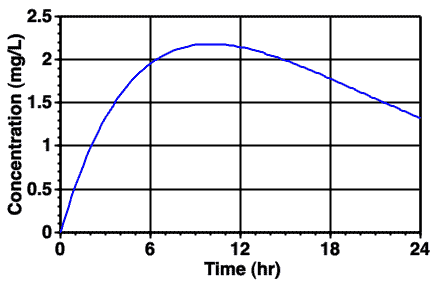
Figure 7.3.1 Typical Plot of Cp versus Time after Buccal Administration
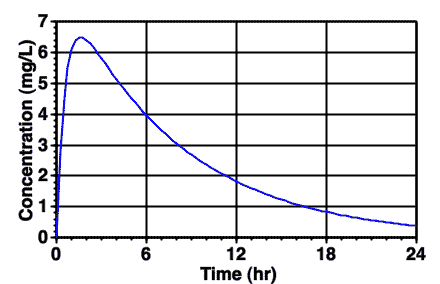
Figure 7.3.2 Typical Plot of Cp versus Time after Sublingual Administration
return to the Course index
previous | next
Material on this website should be used for Educational or Self-Study Purposes Only
Copyright © 2001 - 2026 David W. A. Bourne (david@boomer.org)
| Pharmacy Math Part Two A selection of Pharmacy Math Problems |
|
return to the Course index
previous | next
Advantages:
By-pass liver - Some (but not all) of the veins draining the rectum lead directly to the general circulation thus by-passing the liver. Therefore there may be a reduced first-pass effect.
Useful - This route may be most useful for patients unable to take drugs orally or with younger children.
Disadvantages:
Erratic absorption - Drug absorption from a supppository is often incomplete and erratic. However for some drugs it is quite useful. There is research being conducted to look at methods of improving the extent and variability of rectal administration. Absorption from solutions used as an enema may be more reliable.
Not well accepted. May be some discomfort.
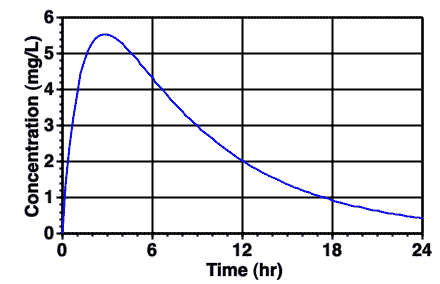
Figure 7.4.1 Typical Plot of Cp versus Time after Rectal Administration
return to the Course index
previous | next
Material on this website should be used for Educational or Self-Study Purposes Only
Copyright © 2001 - 2026 David W. A. Bourne (david@boomer.org)
 | Pharmacy Math Part One A selection of Pharmacy Math Problems |
|
return to the Course index
previous | next
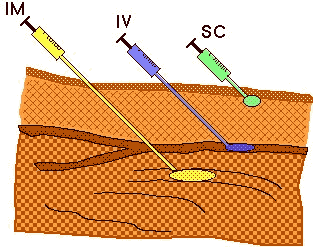
Figure 7.5.1 Showing IV, IM, and SC Injection
Advantages:
Rapid - A quick response is possible. Plasma concentration can be precisely controlled using IV infusion administration.
Total dose - The whole dose is delivered to the blood stream. That is the bioavailability is generally considered to 100% after IV administration. Larger doses may be given by IV infusion over an extended time. Poorly soluble drugs may be given in a larger volume over an extended time period.
Veins relatively insensitive - to irritation by irritant drugs at higher concentration in dosage forms.
Disadvantages:
Suitable vein - It may be difficult to find a suitable vein. There may be some tissue damage at the site of injection.
Maybe toxic - Because of the rapid response, toxicity can be a problem with rapid drug administrations. For drugs where this is a particular problem the dose should be given as an infusion, monitoring for toxicity.
Requires trained personnel - Trained personnel are required to give intravenous injections.
Expensive - Sterility, pyrogen testing and larger volume of solvent means greater cost for preparation, transport and storage.
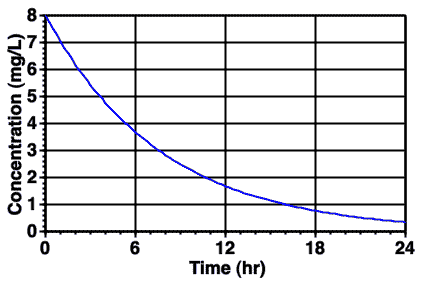
Figure 7.5.2 Typical Plot of Cp versus Time after IV Bolus Administration
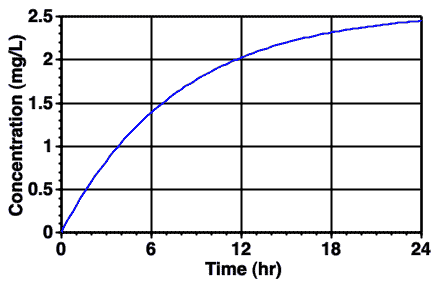
Figure 7.5.3 Typical Plot of Cp versus Time during an IV Infusion Administration
return to the Course index
previous | next
Material on this website should be used for Educational or Self-Study Purposes Only
Copyright © 2001 - 2026 David W. A. Bourne (david@boomer.org)
 | An iPhone app that facilitates the geotagging of Bird Count stops and the return to the same stops during the next and subsequent Bird Count sessions |
|
return to the Course index
previous | next
Advantages:
Can be given by patient, e.g. in the case of insulin.
Absorption can be fast from aqueous solution but slower with depot formulations. Absorption is usually complete. Improved by massage or heat. Vasoconstrictor may be added to reduce the absorption of a local anesthetic agent, thereby prolonging its effect at the site of interest.
Disadvantages:
Can be painful. Finding suitable sites for repeat injection can be a problem.
Irritant drugs can cause local tissue damage.
Maximum of 2 ml injection thus often small doses limit use.
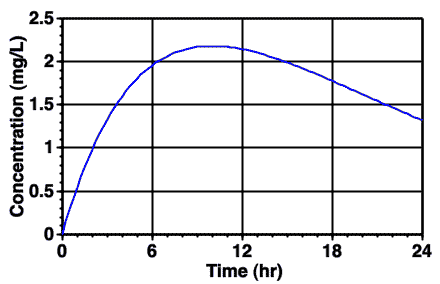
Figure 7.6.1 Typical Plot of Cp versus Time after Subcutaneous Administration
return to the Course index
previous | next
Material on this website should be used for Educational or Self-Study Purposes Only
Copyright © 2001 - 2026 David W. A. Bourne (david@boomer.org)
| A game to aid in interpreting Prescription Sig instructions See how many Sigs you can catch before you run out of lives |
|
return to the Course index
previous | next
Larger volume than SC can be given by IM. They may be easier to administer than IV injections.
A depot or sustained release effect is possible with IM injections, e.g. procaine penicillin.
Disadvantages:
Trained personnel required for injections. The site of injection will influence the absorption, generally the deltoid muscle provides faster and more complete absorption.
Absorption can be rapid from aqueous solution. Absorption is sometimes erratic, especially for poorly soluble drugs, e.g. diazepam, phenytoin. The solvent maybe absorbed faster than the drug causing precipitation of the drug at the site of injection.
Irritiating drug may be painful.
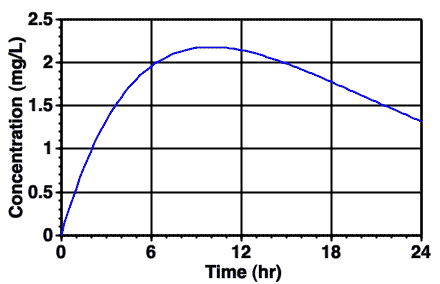
Figure 7.7.1 Typical Plot of Cp versus Time after Intramuscular Administration
return to the Course index
previous | next
Material on this website should be used for Educational or Self-Study Purposes Only
Copyright © 2001 - 2026 David W. A. Bourne (david@boomer.org)
 | An iPhone app that allows the input of up to four locations (latitude and longitude) and provides the user's distance from each location |
|
return to the Course index
previous | next
Can be used for systemic effect, e.g. general anesthesia.
Rapid absorption by-passing the liver.
Absorption of gases is relatively efficient, however solids and liquids are excluded if larger than 20 micron and even then only 10 % of the dose may be absorbed. Cromolyn is taken as a powder with 50 % of the particles within the range of 2 to 6 micron. Larger than 20 micron and the particles impact in the mouth and throat. Smaller than 0.5 micron and they aren't retained. Some portion of the dose may be swallowed.
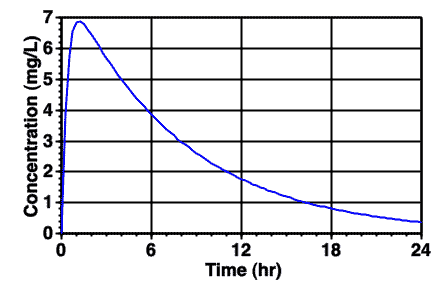
Figure 7.8.1 Typical Plot of Cp versus Time after Inhalation Administration
return to the Course index
previous | next
Material on this website should be used for Educational or Self-Study Purposes Only
Copyright © 2001 - 2026 David W. A. Bourne (david@boomer.org)
| An iPhone app that facilitates the geotagging of Bird Count stops and the return to the same stops during the next and subsequent Bird Count sessions |
|
return to the Course index
previous | next
Systemic effect - e.g., nitroglycerin ointment.
Generally absorption is quite slow. Absorption through the skin especially via cuts and abrasions or from sites were the skin is quite thin can be quite marked. This can be a real problem in handling toxic materials in the laboratory or pharmacy. This can also be a serious problem with garden chemicals.
An occlusive dressing may be used to improve absorption.
Transdermal patches can provide prolonged or controlled (iontophoresis) drug delivery.
There may be some skin irritation. Drug absorption will vary by site of administration, skin condition, age and gender.
Systemic absorption (transdermal) is better with low dose, low MWt, lipid soluble drugs.
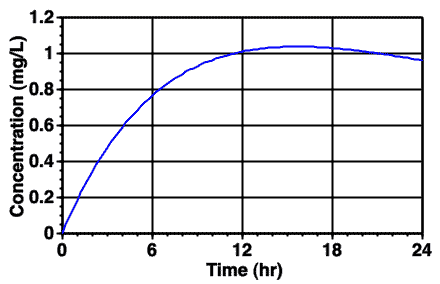
Figure 7.9.1 Typical Plot of Cp versus Time after Topical Administration
Examples of drugs delivered by the transdermal route include estradiol, fentanyl, nicotine (various forms), nifedipine and nitroglycerin.
return to the Course index
previous | next
Material on this website should be used for Educational or Self-Study Purposes Only
Copyright © 2001 - 2026 David W. A. Bourne (david@boomer.org)
 | A tvOS app which presents a collection of video tutorials related to Basic Pharmacokinetics and Pharmacy Math |
|
return to the Course index
previous | next
return to the Course index
previous | next
Material on this website should be used for Educational or Self-Study Purposes Only
Copyright © 2001 - 2026 David W. A. Bourne (david@boomer.org)
 |
The Book Pharmacokinetics This Course in ePub format |
|